
Crowded Teeth Treatment in Seoul with an English-Speaking Orthodontist
Quick answer
Crowded teeth (dental crowding) happen when there is not enough room in the jaw for teeth to line up, so they overlap, twist or sit out of the arch. At Isu Yonsei Baro Orthodontics, Dr. Sally Chaekyung Lee uses CBCT and digital scans to measure the space shortage and explain options such as aligners, braces, expansion or, when needed, extractions.
What crowded teeth are
Crowding means the combined width of your teeth is larger than the space available in the jaw. Orthodontists call this an arch length discrepancy and usually grade it as mild (a few millimeters), moderate or severe. You may notice front teeth that overlap, a tooth pushed toward the tongue or lip, or lower incisors that have slowly become more tangled in adulthood.
Common causes
- Jaw size that is small relative to tooth size, often inherited
- Early loss of baby teeth, allowing neighboring teeth to drift into the space
- Late mesial drift of teeth with age, which can crowd lower front teeth in adults
- Relapse after earlier orthodontic treatment when retainers were not worn
Why it matters
Crowding is not only cosmetic. Overlapping teeth can be harder to brush and floss, which may raise the risk of plaque buildup and gum inflammation in those areas. Severe crowding can also push teeth outside the bone that supports them. Many people simply want a more even smile; that is a valid reason too.
How crowding is diagnosed
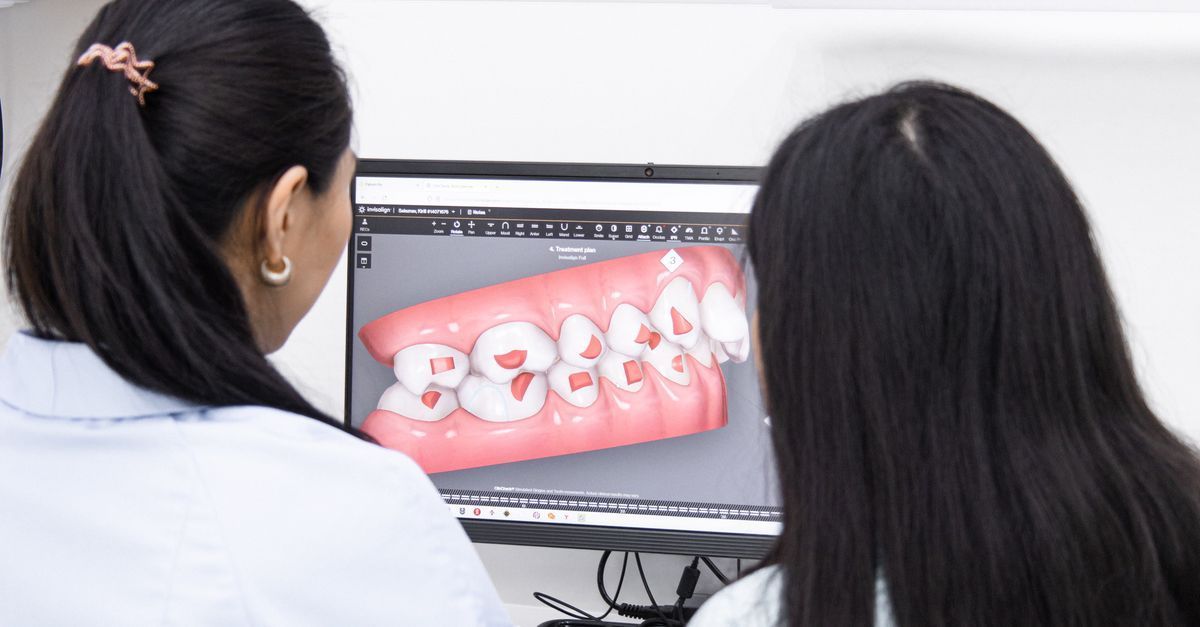
A visual check shows that teeth are crooked, but planning needs measurements. At the first visit an intraoral digital scanner records your teeth in 3D without impression material. A RAY Quantum 5D CT (CBCT) scan shows root positions and how much bone surrounds the teeth, which matters when deciding whether teeth can safely be moved outward. A RAY Face 3D facial scan helps assess how lip support and profile may change with each option.
Treatment options
Mild to moderate crowding is often treated with clear aligners such as Invisalign or Angel Aligner, or with metal, ceramic or lingual braces. Space can be created in several ways:
- Slight arch development where bone allows
- Interproximal reduction (small amounts of enamel polishing between teeth)
- Moving back molars with temporary anchorage devices, an approach discussed in non-extraction orthodontics
- Extractions, when crowding is severe or the lips are already full
If only the front teeth are affected and the bite is otherwise healthy, limited front-teeth treatment may be considered.
Typical timeline
Limited cases may take around 6–12 months, while comprehensive treatment for moderate to severe crowding commonly takes roughly 12–24 months. One published case from the clinic, adult crowding treated with Invisalign without extractions, took 20 months. Retainers are needed afterward because crowded teeth tend to drift back. Individual results and side effects vary; treatment is decided after examination.
What to expect at Isu Yonsei Baro
Your first visit takes about 60 minutes and includes digital scans, X-rays or CT and photos. Dr. Lee reviews the findings with you in English, explains whether extraction or non-extraction approaches fit your case, and gives you a written estimate before you decide. In Dr. Lee's practice, the extraction decision is made by looking at the face and lips as well as the teeth, because the amount of crowding alone does not tell the whole story. She personally follows your treatment from consultation through retention.
At a glance
- Clinical term: dental crowding or arch length discrepancy (mild, moderate or severe)
- Typical treatment time: roughly 6–24 months depending on severity (not a promise)
- Options: Invisalign, Angel Aligner, metal, ceramic or lingual braces
- Space can come from alignment, arch development, minor enamel reshaping, molar distalization or extractions
- Consultation and every explanation in English with Dr. Lee
Your orthodontist
Dr. Sally Chaekyung Lee, DDS, PhD
- MOHW-certified orthodontic specialist
- PhD in Orthodontics, Yonsei University; Severance Hospital residency
- Member, Edward H. Angle Society of Orthodontists
- 2026 AJO-DO peer reviewer
- Consults in fluent English and treats you herself, start to finish
Isu Station Exit 2 · 1-minute walk
Mon & Thu until 9 PM · Sat 9 AM–2 PM
+82 2-592-2080
Frequently asked questions
Can crowded teeth be fixed without pulling teeth?
Often, yes. Mild and many moderate cases can gain space through alignment, small enamel reshaping, arch development or moving molars back with temporary anchorage devices. Severe crowding or very full lips may make extractions the healthier choice. The decision depends on your scans, bone support and facial profile, and is made after an examination.
Why are my lower front teeth getting more crowded as an adult?
Teeth naturally tend to drift forward slightly over a lifetime, and the lower incisors are often the first to show it. Lost retainers after earlier braces, gum changes and missing back teeth can also contribute. An orthodontist can measure the change and suggest whether limited or full treatment makes sense.
Are clear aligners effective for crowding?
Clear aligners can treat many crowding cases, especially mild to moderate ones, when they are planned carefully and worn about 20–22 hours a day. Severe rotations or large space shortages may respond more predictably to braces or a combined approach. Dr. Lee explains the trade-offs for your specific teeth at the consultation.
How much does crowding treatment cost in Seoul?
Fees depend on severity, the appliance chosen and how long treatment takes, so they cannot be quoted from photos. After an exam with scans you receive a written estimate in English. Orthodontic treatment is typically not covered by Korean National Health Insurance, although some private overseas plans may reimburse part of it.
Related reading
This page is general information, not a diagnosis. Individual results and side effects vary; treatment is decided after an in-person examination. See our editorial and medical review policy .
Talk to Dr. Lee in English
Send your concern and preferred dates. You'll get an examination, your options, a timeline and a written estimate before you decide anything.